Anyon Computing Runs Real-Time Error Decoding Loop for Superconducting Quantum Processors With NVIDIA NVQLink
EMERYVILLE, Calif., Nov. 16, 2026
Anyon plans to share its proof-of-concept control architecture for quantum supercomputers openly with builders of quantum control systems
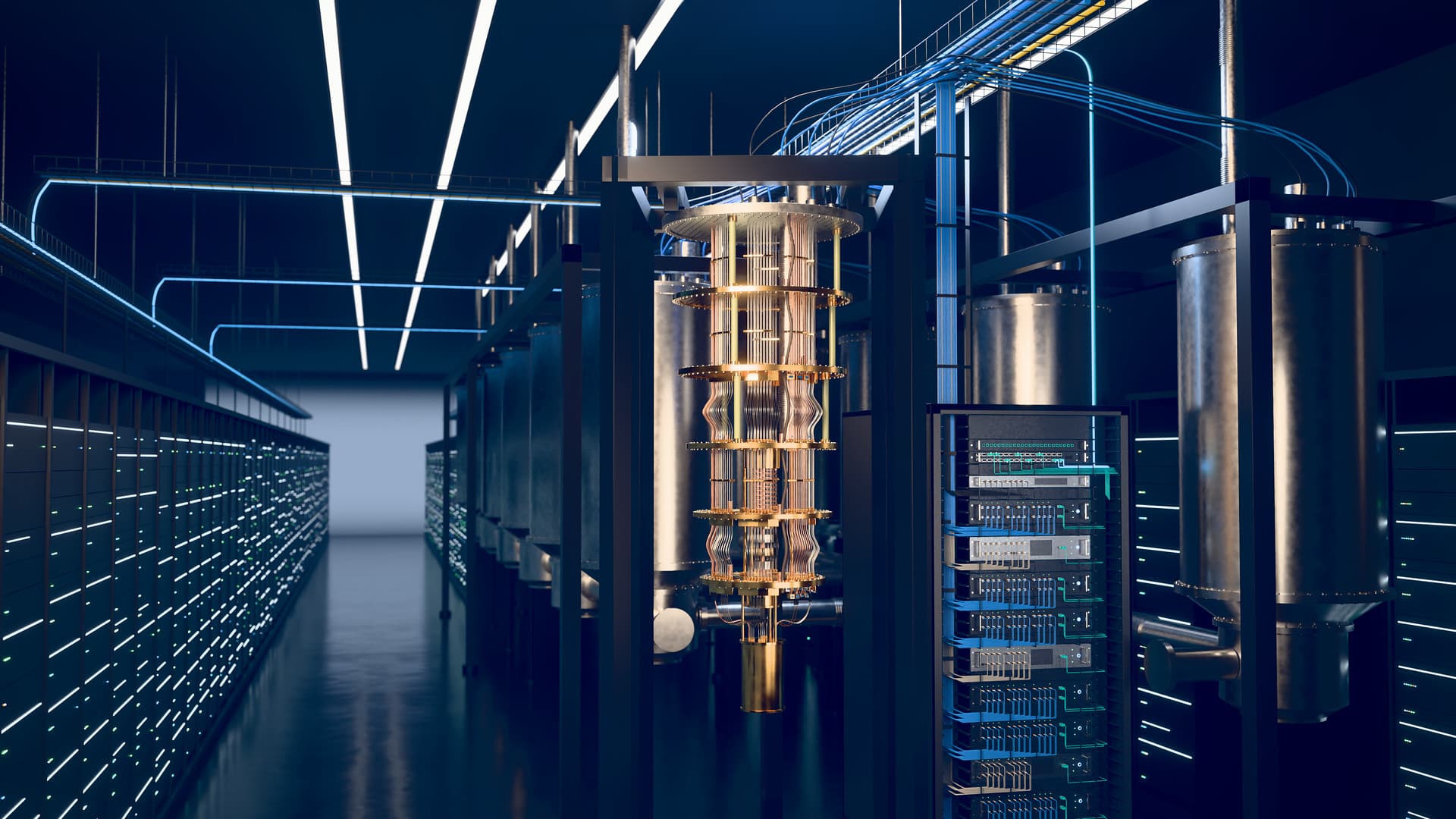
Rendering.
Anyon Computing today announced that it has run a real-time error decoding loop with NVIDIA NVQLink for superconducting quantum processors. The loop is part of a proof-of-concept control architecture that Anyon is building and plans to share openly with builders of quantum control systems, to accelerate the development of million-qubit quantum supercomputing clusters with thousands of logical qubits, tightly coupled with classical supercomputers in the same computing infrastructure.
NVQLink is NVIDIA’s open system architecture for tightly coupling quantum processors with GPU supercomputers. In each round of the loop, the control system performed mid-circuit measurements and sent the results over a low-latency RDMA network to a real-time host server. NVIDIA CUDA-Q Realtime passed the results to a decoder, and the control system applied the decoder’s correction in the next round.
Fault-tolerant quantum computers will depend on quantum error correction, in which qubits are measured repeatedly and classical decoders determine the corrections. The results must be processed and acted on within microseconds. As systems grow to millions of qubits in future supercomputing infrastructure, decoding will run on GPU-accelerated computers connected to the control systems over a low-latency network.
The control system uses NVIDIA CUDA-Q Realtime, a library for tightly coupling GPU-accelerated compute to the control system of a quantum processor. The controllers write each round’s measurement results directly into the real-time host’s memory, already formatted as CUDA-Q Realtime requests, so that CUDA-Q Realtime reads them in place without copying. The controllers connect to the real-time host using RDMA over Converged Ethernet (RoCE), the networking technology used by NVQLink and widely deployed in high-performance computing and AI data centers. Each controller implements RoCE in its own programmable logic and works with standard Linux RDMA software and NVIDIA ConnectX network adapters.
Decoding is software-defined: decoders are software that can be downloaded and installed on the real-time host servers, so a decoder can be updated or replaced, for example for a different error-correction code, without changing the control hardware. The decoders are designed to run on GPUs or CPUs in the host servers through the same interface.
The control architecture is designed for large-scale, fault-tolerant systems built from multiple quantum processors linked by quantum interconnects that distribute entanglement between them (Figure 1). Synchronized control systems operate each processor and connect to GPU-accelerated computing over a shared, low-latency RDMA network. In each error-correction cycle, measurement results from all processors are decoded together on GPUs, and corrections are returned to the control systems in real time (Figure 2).
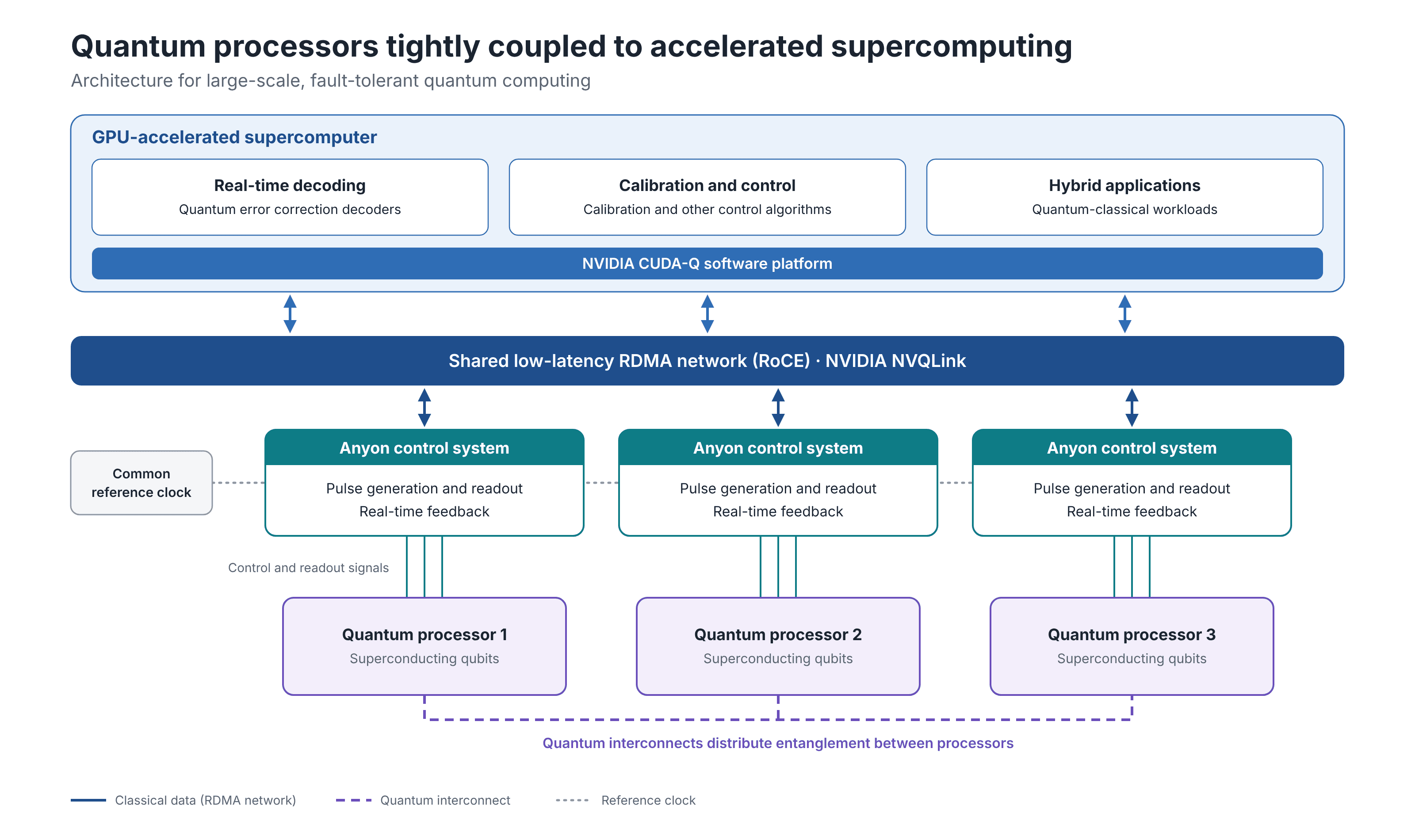
Figure 1
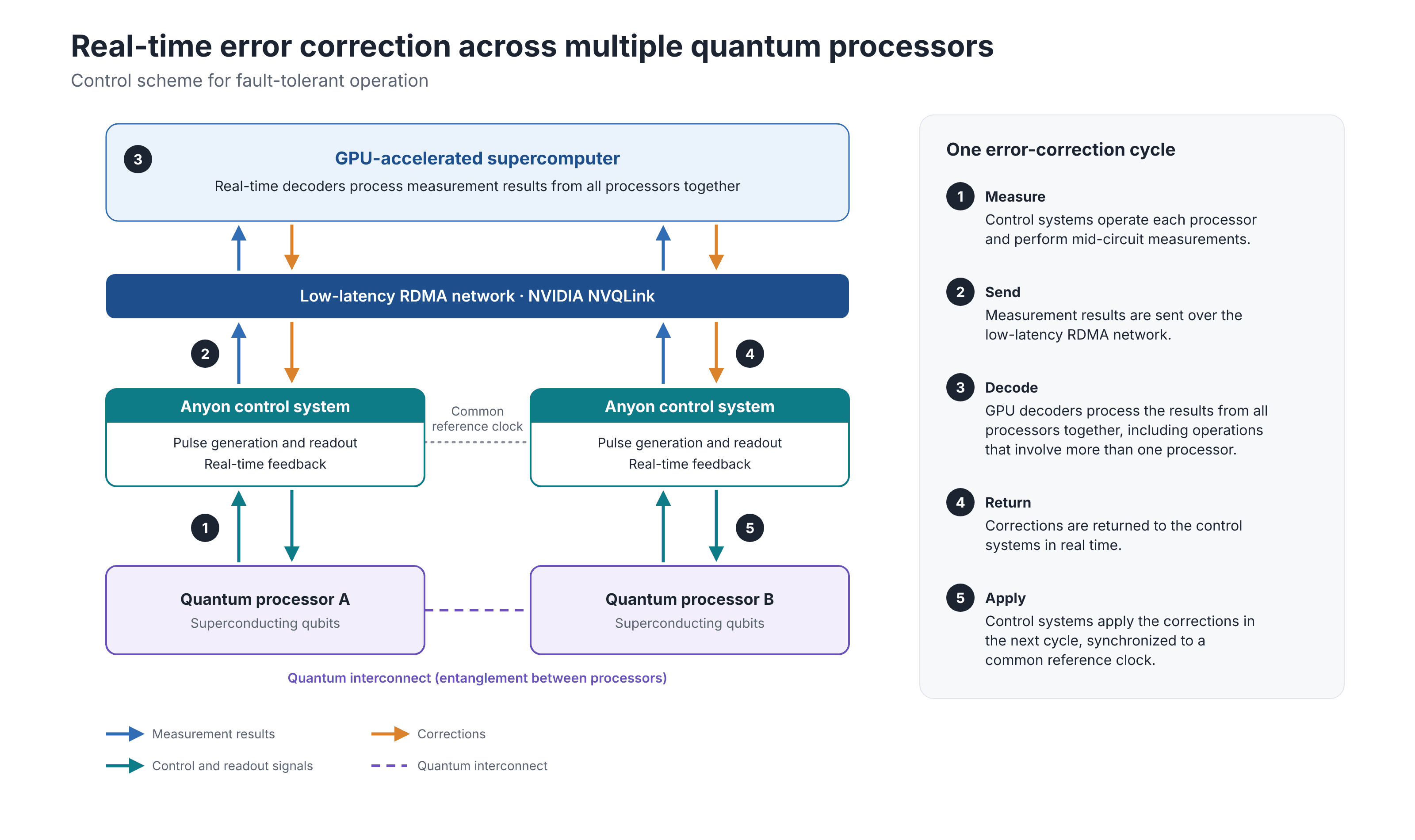
Figure 2
Figure 3 shows the main blocks of Anyon’s controller and the real-time host server, and how measurement results and corrections move between them in each error-correction round.
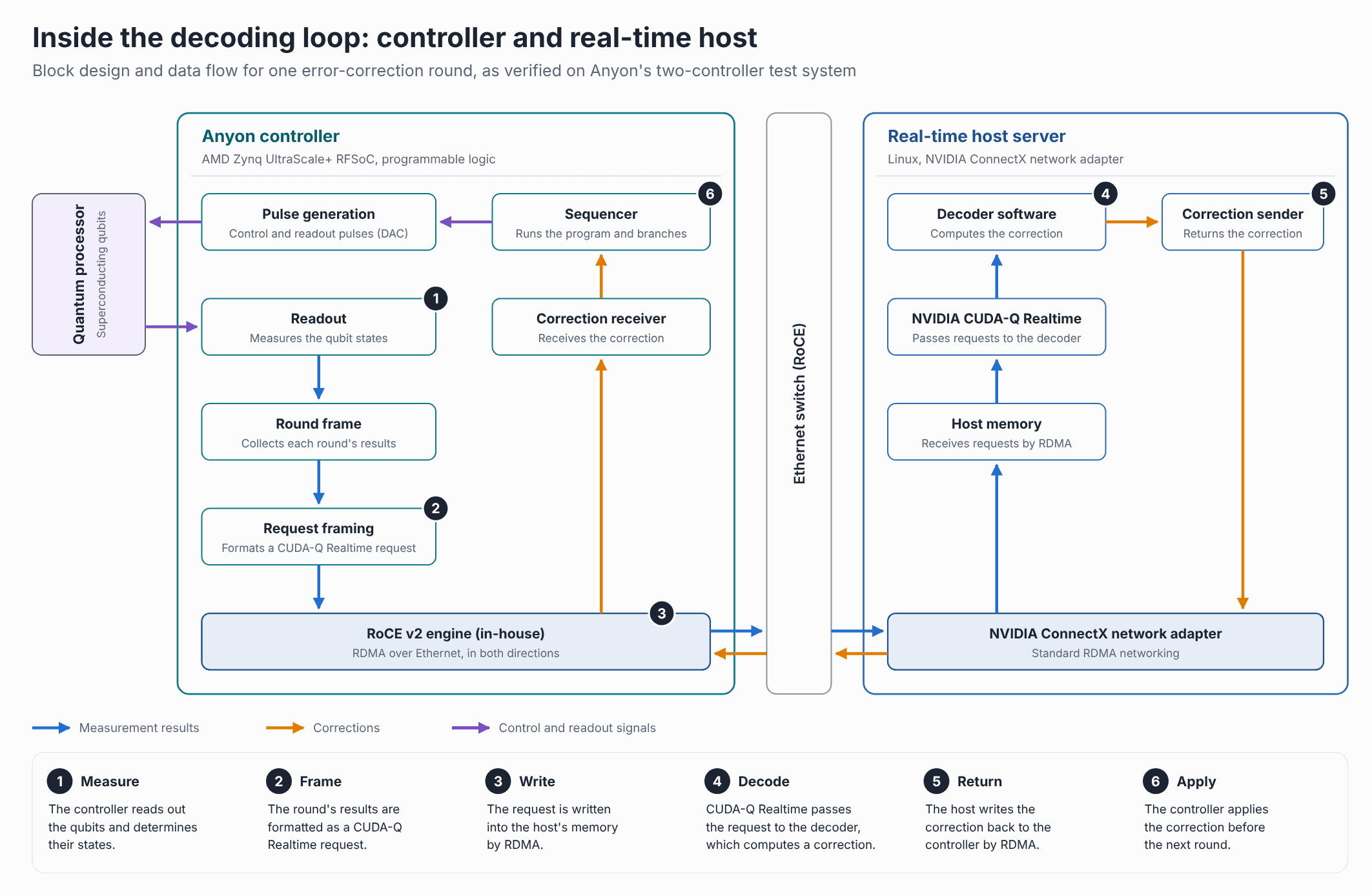
Figure 3
The demonstration builds on the real-time quantum control system that Anyon introduced in September 2026 and plans to release as open source. The proof-of-concept system includes:
- Software-defined decoding: Measurement results are passed through NVIDIA CUDA-Q Realtime to decoders that run as software on the real-time host servers, and corrections are applied in the next round.
- Real-time feedback: Mid-circuit measurement results are processed in the controller itself, so conditional operations can run without waiting for a host computer. Conditions can combine several results, such as their parity.
- Multi-controller operation: Controllers share a common reference clock and exchange measurement results directly with each other over the same network, without a host computer in the data path.
- Logical qubits and lattice surgery: Runs programs on surface-code logical qubits, including lattice surgery between logical qubits on different controllers. A logical qubit can span two controllers, and a program can measure it in the Z or X basis and branch on the decoded result.
- Decoders: Includes union-find, minimum-weight matching and neural-network decoders. Decoders from the NVIDIA CUDA-Q QEC library can also be installed on the real-time host servers and used in the decoding loop.
- Leakage handling: Detects qubits that have leaked out of their computational states and accounts for them in decoding.
- Supercomputer job scheduling: Works with Slurm, the workload manager widely used at supercomputing centers. The real-time host runs as a Slurm node, jobs request the quantum processor as a resource in the same way they request GPUs, and the controllers are prepared for each job when it starts and released when it ends (Figure 4).
- Standard programming tools: Programs can be written with the NVIDIA CUDA-Q open source platform, OpenQASM or QIR.
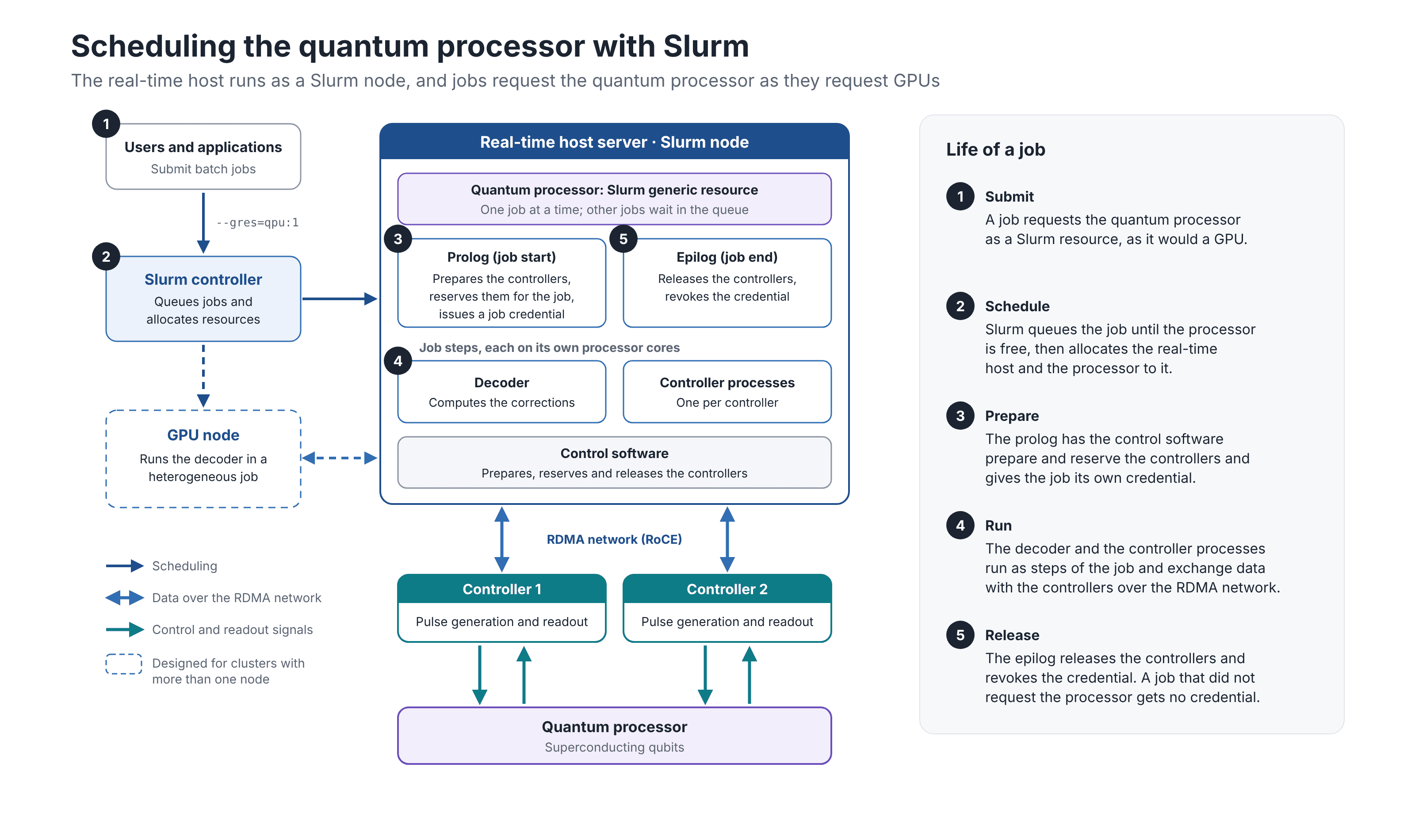
Figure 4
“Large-scale, fault-tolerant quantum computers will be built as clusters of interconnected quantum processors tightly coupled to GPU supercomputers, and their error correction will have to run in real time,” said Dr. Jie (Roger) Luo, cofounder and CEO of Anyon Computing. “Running a real-time error decoding loop with NVIDIA NVQLink and CUDA-Q Realtime is a step toward those systems. We will share this control architecture openly so that builders of quantum control systems can use it in their own designs.”
“Quantum error correction is advancing rapidly, and builders need systems that can evolve with the science,” said Sam Stanwyck, Director of Quantum Product at NVIDIA. “With NVIDIA CUDA-Q and NVQLink, Anyon is demonstrating how new decoding algorithms can be deployed as software within a real-time quantum control loop. Sharing that architecture openly gives more developers a starting point for building accelerated quantum supercomputers.”
About Anyon Computing
Anyon Computing Inc. (also known as Anyon Technologies) is a quantum supercomputer company that develops interconnected superconducting quantum supercomputing clusters, which it tightly couples with NVIDIA GPUs via NVQLink for data center deployment at scale. Anyon pioneered deploying NVIDIA NVQLink inside a commercial production data center and is among the first superconducting QPU backends integrated with NVIDIA CUDA-Q. Founded by pioneers from Caltech and UC Berkeley. https://www.anyoncomputing.com/
NVIDIA, ConnectX, CUDA-Q and NVQLink are trademarks and/or registered trademarks of NVIDIA Corporation in the U.S. and other countries. Other company and product names may be trademarks of the respective companies with which they are associated.
Media contactAnyon Computing · info@anyoncomputing.com
Related
- Anyon Computing Unveils New Open Quantum Control System, Making Quantum Processors Co-Processor Nodes Alongside GPUs and CPUs in One Machine with NVIDIA NVQLink
- Deploy World's First Tightly Coupled Hybrid Quantum Computing Commercial Data Center and Drive Quantum-AI Applications with Anyon
- Upgrading AI Computing Infrastructure into Accelerated Quantum-AI Supercomputers with NVIDIA NVQLink and CUDA-Q